
For a long time, when one of my factory-style or survival crafting bases went quiet, I reacted the same way: I went mining, I went chopping, I queued up more of whatever looked low in the storage screen. More often than not, the resource in question was already sitting in another chest, and the real reason nothing was moving was the layout itself. Knowing how to tell a true shortage apart from a bad production layout has saved me more hours than any specific recipe, and it sits at the heart of any strategy game resource management guide worth reading. The two failures look identical on screen: an empty output bin. The fix is not the same.
The Two Failure Modes That Look Identical
When the storage screen shows an empty output bin, the natural assumption is that I do not have enough of the resource that fills it. In my experience, that assumption is wrong more than half the time. The bin is empty because the chain that should fill it is stalled, and the chain is stalled because the layout, the ratios, or the buffering is off. The actual resource is in the base. It just never arrives.
Here is the distinction I have learned to draw before I do anything else:
True shortage — the upstream sources are producing slower than the downstream consumption, or they are not producing at all.
Bad production layout — the sources are producing plenty, but the throughput between source and destination is broken.
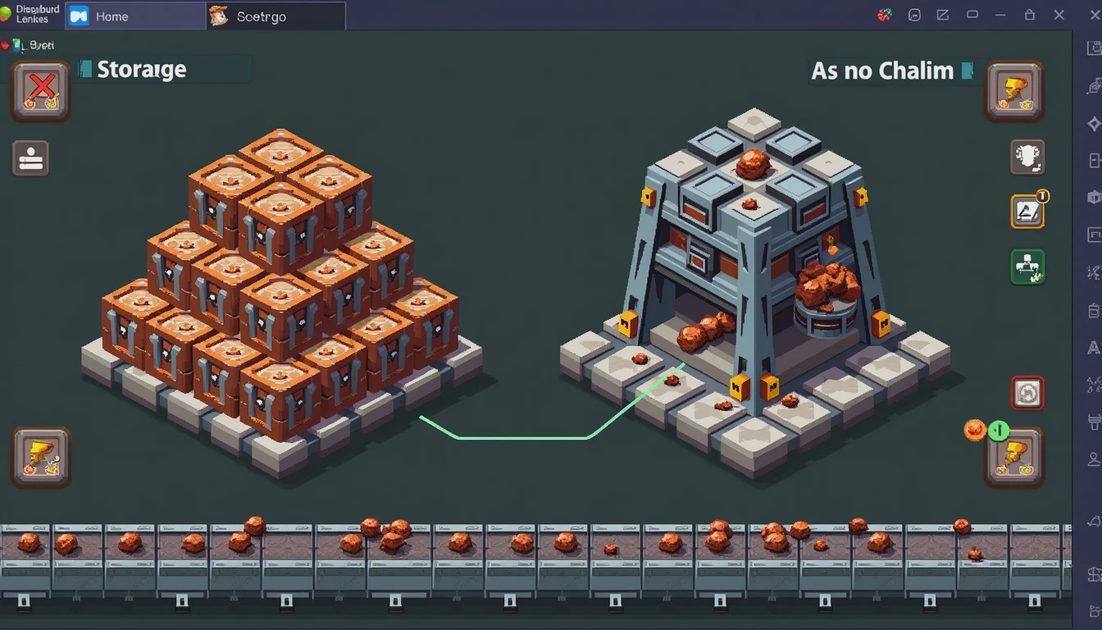
Both end with an empty output bin. Both feel identical until you open the routing screen. Save your time for the fun stuff by deciding which one you have before you spend an hour on the wrong fix. Digging for more ore when the ore is already piled up next door is one of the most common wastes of a session I know.
How the Two Problems Disguise Each Other
Shortages and bad layouts tend to mask each other in subtle ways. A true shortage makes me blame the layout, because my machines look busy and yet nothing comes out. A bad layout makes me blame the world, because the resource counter never seems to grow even though I am gathering as fast as I can. In both cases, I reach for the wrong tool. The only way out of that loop is a quick diagnostic, not a reflex.
That diagnostic is the part I wish I had learned earlier. It does not take long. It does not require a rebuild. It only asks me to look at one chain end to end and check whether the inputs are actually missing or whether they are sitting on the wrong side of a broken belt. Most of the time, the answer becomes obvious within a couple of minutes, and the fix follows.
A Decision Table for Telling Them Apart
The shortest distance between "I am confused" and "I am fixing the right thing" is a checklist. After many wasted sessions, I settled on one I keep taped inside my notebook. When a chain stalls, I run the symptom through this table first and let the third column tell me what to do.
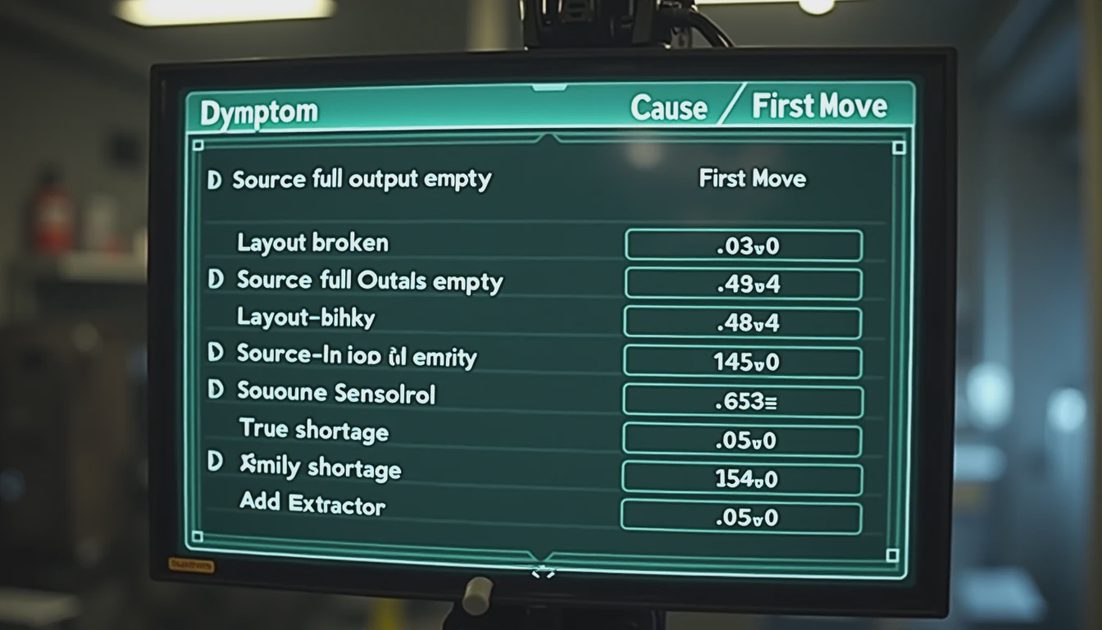
Symptom I See | Likely Cause | First Move to Make |
|---|---|---|
Output bin is empty, source chests are full, machines look busy | Bad layout, transport is broken | Reroute or widen the belt between source and destination |
Output bin is empty, source chests are empty, machines are idle | True shortage | Trace upstream and add more extractors or smelters |
Output bin fills in bursts then empties completely | Buffer is too small between stages | Add a buffer chest between the producing and consuming stages |
Output bin fills consistently but never quite reaches demand | Ratio mismatch, downstream consumes faster than upstream produces | Either widen upstream or split downstream demand across multiple destinations |
Output bin is full but downstream machine keeps stalling | Destination stage is broken, not the source | Diagnose the downstream stage separately |
Output bin swings between full and empty at regular intervals | Splitting or balancing is missing on a shared line | Add a splitter or merge to balance two producers and two consumers |
Reading the table takes a moment, but it has saved me from rebuilding a base that did not need rebuilding. The first move column is what I actually do that night. The other columns I leave for another session, because most problems have one root cause and chasing every column at once just makes the base worse.
How to Read the Table on a Weeknight
When I only have ninety minutes, I do not run the full table. I pick the single symptom that matches what I see on screen, take the first move from the matching row, and stop. The other symptoms either go away once the first move lands or they show up clearly on the next session. This is one of the few places where a smaller fix beats a larger one. A single belt reroute, a single splitter, or a single buffer chest is often all it takes to turn a stalled chain back on.
The table also helps me avoid the worst reflex in any strategy game resource management guide: blaming the resource itself. The world does not usually need more ore. It usually needs fewer broken belts.
Ratios and Balancing: Why Layout Beats Inventory
Most of the chains I run into fail because of ratios, not shortages. A ratio problem is when one stage of a chain produces faster or slower than the next stage can accept, and the slower stage caps the whole chain. I have built bases with five smelters feeding one forge and been confused that the smelters were always idle. Five into one is not a recipe, it is a bottleneck pretending to be a setup. Ratios are the reason so much of what passes for a strategy game resource management guide actually boils down to layout rather than inventory.
Ratios are a layout problem dressed up as a resource problem. The fix is to size every stage to match the slowest one, then add a single buffer chest between stages so each stage can keep running while the others catch up. When I follow that one rule, my bases stop oscillating between full chests and empty bins. They produce a steady output that I can plan my evening around.
Splitting and balancing are the second half of the same idea. A splitter takes one input and divides it across two outputs. A balancer takes two inputs and keeps them even. Without them, a single shared line will starve one consumer whenever the other consumer is busy. Add a splitter when one source feeds two destinations. Add a balancer when two sources feed two destinations and you want them to share the load evenly. These two pieces of infrastructure are the layout-level equivalent of how to manage resources in survival games without owning twice as many raw piles as you actually need.
Buffering: When Storage Is the Answer, Not the Cause
There is one case where more storage is the right answer, and it is worth being clear about it because the rest of this article suggests otherwise. When a chain has multiple stages with slightly different cycle times, a buffer chest between them lets the faster stage run ahead and store up output for the slower stage. Without the buffer, every minor cycle mismatch stalls the faster stage and the chain grinds to a stop. With the buffer, the chain runs at the speed of the slower stage without ever fully idling.
A buffer is not a substitute for fixing a broken belt or for adding a missing extractor. It is the third tool, after routing and ratios, that lets a chain run smoothly across the gaps between stages. When I add one in the right place, I do not need to add more raw resources anywhere in the base. The resource was always there. The buffer just gives the system permission to breathe.
That is the whole lesson. Most of the time, the chain is not running out of anything. It is running out of throughput, balance, or buffer. Treat your base as a system of flows rather than a system of piles, and the empty bins start to disappear on their own. That is the kind of habit that turns an eighty-hour save file into a base I actually enjoy opening up after work.