
If a factory-style logistics game or a survival crafting title has ever left you staring at a half-built production line wondering why nothing is moving, this strategy game resource management guide is for you. Production chains are the single system that decides whether your base hums along or grinds to a halt, and once you can read a chain end-to-end, the games that look complicated on YouTube start to feel manageable on a Tuesday evening. The trick is not memorizing recipes. It is learning to see the chain itself as a system, then walking it from raw material to useful output one step at a time.
What a Production Chain Actually Is
A production chain is the full sequence that turns raw stuff you find or mine into something your character actually uses. Most chains follow the same skeleton, even when the games look completely different on the surface. In a logistics game you are moving ore between smelters. In a fantasy survival crafting game you are smelting, weaving, and assembling gear. The verbs change, but the shape is identical.
Here is how I learned to talk about any chain in plain language, regardless of genre:
Inputs — what enters the chain. Usually raw resources you harvest or extract.
Processes — the machines, crafting stations, or recipes that transform one input into another.
Outputs — what comes out at the end. Almost always something consumable, equippable, or tradeable.
Byproducts — anything the chain produces along the way that you can use or sell elsewhere.
That four-part vocabulary is enough to describe almost every chain I have run into. Once you have it, you can open any new game, point at any recipe, and start sketching it on the back of an envelope without panicking. Keep it simple: if you cannot describe a chain in those four terms, you do not yet understand it well enough to build it at scale. That single sentence is the backbone of how I write any strategy game resource management guide for friends who ask why their base has stopped producing.
Why Chains Feel Overwhelming at First
When a game first shows you a dozen recipes on a single crafting screen, your brain wants to read them like a menu and pick whichever one looks useful. That is exactly backwards. A recipe only makes sense inside the chain it belongs to, and the chain only makes sense once you can name its inputs, processes, outputs, and byproducts. The menu view flattens the system; the chain view restores the system. The shift from menu-thinking to chain-thinking is the moment a survival crafting game progression guide stops being theory and starts being a tool you actually use.
The Four Stages Most Chains Share
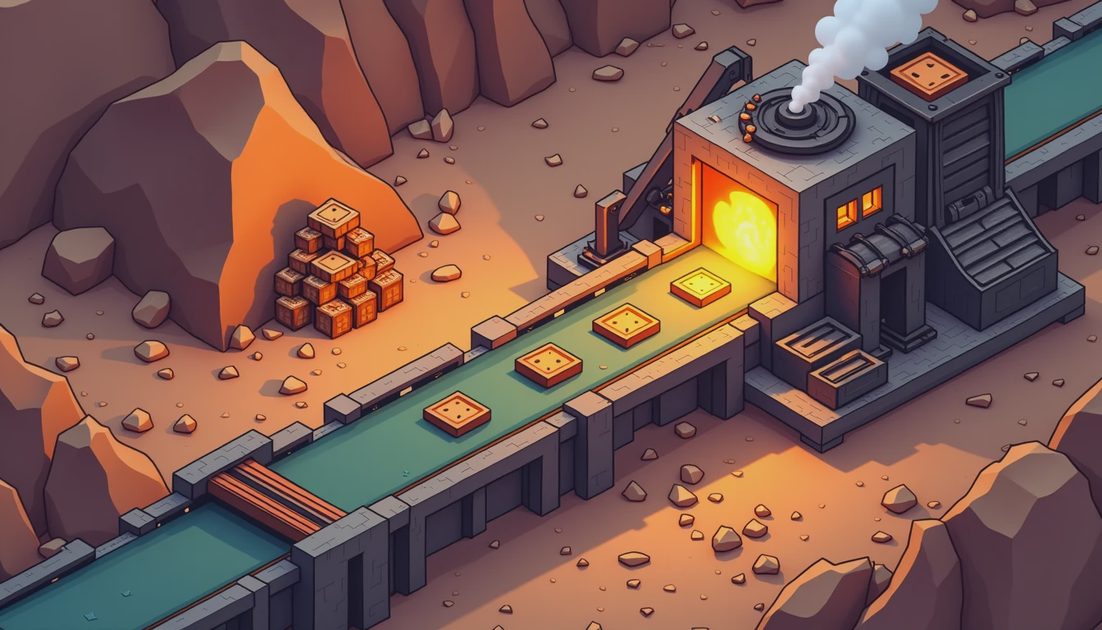
After running hundreds of chains across a dozen different games, I have stopped trying to memorize the specific recipes. Instead, I think in terms of stages. Almost every chain in any of these games passes through the same general stages, even if the machines and the resources are wildly different.
Here is the table I keep taped to the inside of my notebook for reference.
Stage | What Happens | Typical Examples | Common Bottleneck |
|---|---|---|---|
Raw extraction | Pulling resources out of the world | Mining, chopping, drilling, pumping | Tool tier, area access |
Processing | Refining raw into usable intermediates | Smelting, refining, milling, weaving | Machine speed, fuel supply |
Assembly | Combining intermediates into final components | Crafting benches, assembly lines, forges | Crafting queue size, recipe unlocks |
Consumable output | Producing what the player actually uses | Ammo, healing items, gear, trade goods | Throughput, storage, transport |
A clean chain runs from left to right, raw extraction feeding into processing, processing feeding into assembly, and assembly feeding into consumable output. When you read a recipe, ask which stage it lives in. When you read a machine, ask which stage it serves. The map of your base becomes a chain diagram before you place a single machine.
How to Read the Stages on a Real Game Screen
When I open a new game, I scroll through the crafting screen slowly and tag every recipe with one of those four stage labels. The work takes about ten minutes and it pays back for the entire rest of the playthrough. Suddenly the crafting menu is not a wall of icons. It is a chain I can sketch on paper, with arrows pointing from the recipes I can make today toward the recipes I cannot make until I build more infrastructure.
Here is the short sequence I follow:
List every raw resource I can currently gather without upgrading.
Tag each craftable recipe with its stage: raw, processed, assembled, or consumable.
Draw arrows from each recipe to what it can produce next.
Highlight any chain that ends in something I actually need for tonight's play session.
Build only the chains that light up in step four, and ignore the rest until later.
That step five is the one most players skip, and it is the one that decides whether your base is useful or a museum of half-finished projects. Save your time for the fun stuff: the chains that turn raw resources into things you will actually equip or consume this week.
A Worked Example Chain
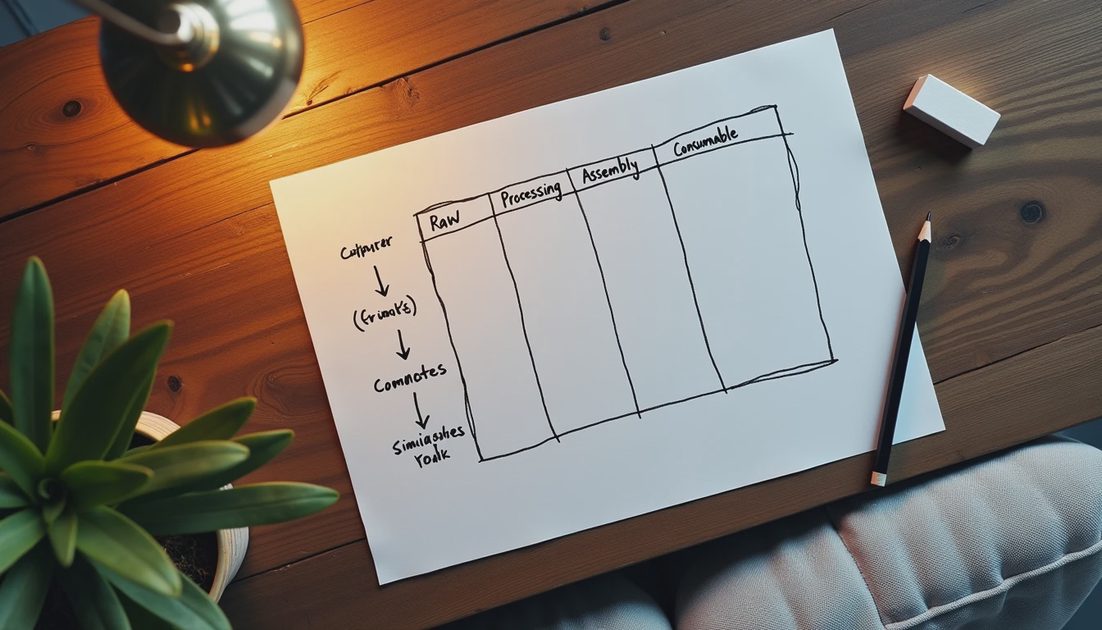
A concrete example makes the abstract stages easier to hold in your head. Imagine a generic survival crafting game with a heavy base-building loop. This is the kind of worked example every good strategy game resource management guide leans on, because seeing one full chain from raw material to consumable output is what clicks the whole system into place for most players. Here is a chain I might build on a slow weeknight:
Raw extraction: I run a small copper mining outpost that pulls copper ore out of a nearby hill.
Processing: The ore rides a conveyor into a smelter that produces copper ingots and a small amount of slag as a byproduct.
Assembly: The ingots reach a forge where they combine with rough leather into copper-reinforced tool heads.
Consumable output: The tool heads move to a workbench where they attach to wooden handles and produce a stack of upgraded pickaxes.
End to end, that is one chain. The pickaxes in my inventory came from copper ore I dug up two hours ago. Read top to bottom, the chain looks simple. Built bottom to top on a real base, it is anything but simple. The mistakes players make almost always come from building the chain in the wrong order, or from leaving out one of the four stages entirely.
Where Players Most Often Break a Chain
When a chain stalls, the cause is almost always one of five familiar problems. Knowing which one you have saves you from rebuilding half your base.
Missing stage: you skipped a processing step and tried to assemble from raw resources directly.
Wrong ratio: the machines that feed each other produce at different speeds, and the slowest stage caps the whole chain.
Storage gap: a machine finishes its work but has nowhere to put the output, so it halts.
Power or fuel interruption: a machine stops because it ran out of fuel or electricity.
Transport choke: the belt, pipe, or path between machines is too narrow to carry what the upstream stage is producing.
When I diagnose a stalled chain, I walk it in order from raw extraction to consumable output and check each of those five problems. Most of the time, the answer is one of the first three. Once you spot it, the fix is usually small: add a single machine, widen a single belt, or move a chest.
Building Chains That Scale
The last habit that has saved me the most hours is planning the chain at the size I expect to need in two or three sessions, not at the size it is right now. A base that looks tidy at level one becomes a tangled mess at level four, and the games rarely give you a clean way to rip it out and start over.
So before I commit to a layout, I sketch the chain I want at the size I will likely need in a few weeks, and I leave room around every stage for one extra machine and one extra belt line. That breathing room is the difference between a base I can extend on a weeknight and a base I have to demolish when the next tier unlocks. Treat the chain as a living diagram rather than a finished blueprint, and your base will keep up with the game instead of dragging behind it. That, more than any specific recipe, is what this survival crafting game progression guide is really trying to teach.