The single most expensive save you make in any weeknight gaming session is not the save at the end. It's the one you make twenty minutes before bedtime, when you tell yourself you'll just do one more thing and then quit. That "one more thing" is where the bedtime save gets lost, the bedtime argument with your partner starts, and the bedtime frustration that follows you to sleep gets built. Most of my bad weeknight sessions didn't start badly. They ended badly because I misjudged the stop. Here's what I'd do: treat stopping as a skill you practice, not a moment you negotiate.
This article is the stopping skill I use to plan what to do in a two hour gaming session without bleeding into the next morning. If you take the rubric at the end and use it three or four times, you'll find that the "one more thing" trap stops feeling like a choice you make and starts feeling like a pattern you recognize.
The Save You Forget Is the One That Costs You Sleep
There's a specific kind of save I think about a lot. It's the save where you have twenty minutes of game time, you tell yourself you'll do one quick thing, and then the one quick thing turns into a forty-five-minute detour. By the time you realize it's late, you've either force-quit at a bad spot, lost some progress, or had to stay up past your own bedtime to clean up the mess. That save is the one that costs you sleep. It's the one that turns a hobby into a source of friction.
The reason this save is so expensive is that the cost is invisible at the moment. You feel fine while you're playing. The cost arrives an hour later, when you're trying to fall asleep and your brain is replaying the lost progress, the unfinished quest, or the argument with your partner about lights-out. That cost is the real cost of a bad stop. The in-game cost — losing a few minutes of progress — is small. The bedtime cost — losing sleep, peace, and goodwill — is large.
The two clocks you're actually managing
When you sit down for a weeknight session, you're not managing one clock. You're managing two. The first clock is the in-game clock. The second clock is the real-world bedtime clock. The first one feels urgent because it has visible numbers ticking. The second one feels abstract until you miss it. In my experience, the players who have the cleanest stops are the ones who treat the real-world clock as the more important of the two, and the in-game clock as a constraint to work around.
Recognizing the "One More Thing" Trap
The "one more thing" trap has a recognizable shape. It always looks small when it starts. "I'll just pick up this one resource." "I'll just finish this one room." "I'll just talk to this one NPC." Each of those sentences, on its own, sounds like a five-minute task. They almost never are. They almost always turn into twenty-five-minute tasks, because each one of them pulls you past the wrap-up block you already allocated for yourself.
The trap works because the cost of doing the thing is visible and immediate, and the cost of stopping is invisible and delayed. If you do the thing, you get a small in-game reward right now. If you stop, you get a vague future reward (more sleep, less friction) that doesn't feel as real in the moment. That's why the trap is so sticky. You have to actively decide to value the future reward over the immediate one.
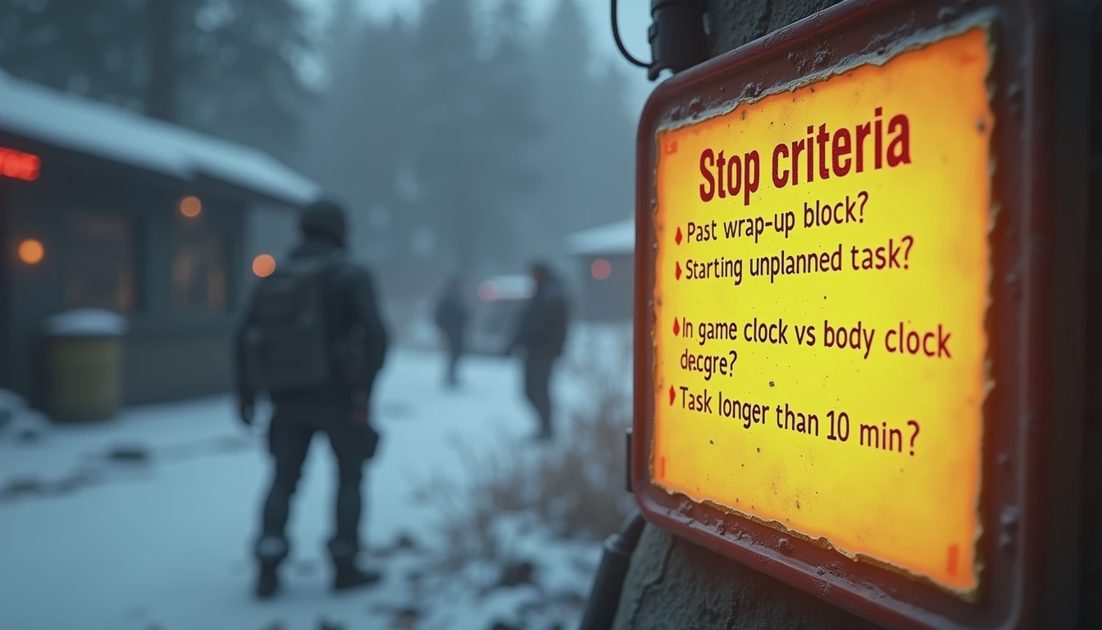
Three signals tell me the trap has started and I need to stop talking myself into one more thing:
The session is past the wrap-up block I set for myself.
I'm starting a task I didn't plan to start at the start of the night.
The screen clock says one time and my body clock says another.
If two of those three are true, the answer is to stop. Not to negotiate. Stop.
Why willpower doesn't work here
The standard advice for breaking a habit is to use willpower. That doesn't work for weeknight gaming because the moment you're most tempted to keep playing is the moment you're least able to use willpower well. You're tired, you've had a long day, your brain is looking for a low-effort reward. That's not a willpower problem. It's a clock problem. Move the clock earlier in the session — set the wrap-up alarm twenty minutes before you actually need to stop — and you never have to fight your tired self at the worst possible moment.
A Short Rubric for the End of the Night
Here is the four-question rubric I run through when I'm tempted to keep playing. I keep it on a sticky note on the monitor. It takes about thirty seconds to walk through, and it's the difference between stopping cleanly and stopping in a fight:
Question | If yes, stop now |
|---|---|
Am I past the wrap-up block I set at the start of the session? | Yes |
Am I starting a task I did not plan at the start of the night? | Yes |
Is the in-game clock and my body clock disagreeing? | Yes |
Is the task I'm about to start going to take longer than ten minutes? | Yes |
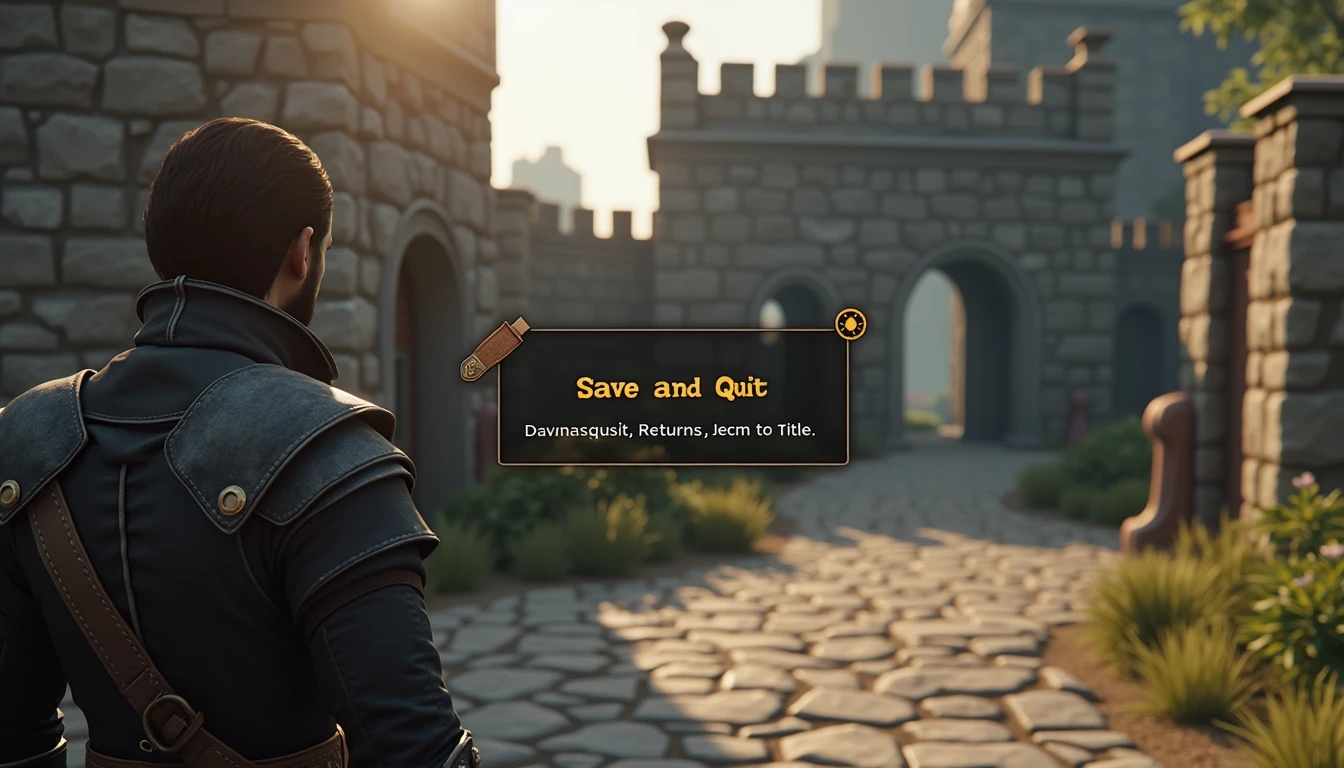
If two or more answers are yes, the session is over. Walk through the shutdown steps — bank loot, park the character, drop a pin, close the game — and the session ends. The session does not end when the current task finishes. The session ends when the rubric says it ends. This rubric is the single most reliable way I've found to plan what to do in a two hour gaming session without overrunning it.
A note on the "one more save" lie
There is a related trap called the "one more save" lie. It's the belief that saving your game is the same as quitting your game. It isn't. Saving your game is a technical step. Quitting your game is a decision. You can save the game, close the application, and walk away. The save does not require you to start a new task. If you find yourself saving and then immediately starting one more fight, one more room, or one more conversation, the save was a half-finish, not a stop. Close the application instead of the menu.
Good Stopping Points Worth Planning For
The last piece of the stopping skill is to plan your stopping points before you start playing. If you walk into a session without knowing where you'd be willing to stop, you will end up stopping wherever the wrap-up alarm catches you, which is usually the worst possible place. If you walk in knowing two or three good stopping points, you'll find it much easier to actually stop when you reach one.
Here are the stopping-point types I plan around. They're the kinds of natural breaks that any game surfaces if you look for them:
After banking loot or restocking at a vendor.
After clearing one dungeon room or one enemy camp.
After handing in one quest or finishing one quest step.
After upgrading one bench, weapon, or piece of gear.
After walking your character to a fast-travel point or hub area.
After reading one journal entry or hearing one piece of story dialogue.
After the closing cutscene of any quest, never during one.
Any of these is a clean stop. Most games give you at least two of these in any ninety-minute session if you know to look for them. The habit is to notice them in advance, not to react to them in the moment. When you're planning what to do in a two hour gaming session, the stopping-point list is just as important as the goal list — maybe more so, because the stop is what protects tomorrow.
Pre-commit the stop, not the goal
The most useful weeknight habit I have is to pre-commit the stop, not the goal. Before I sit down, I decide where I'm going to be when I quit. Then I pick the goal that fits inside that stop. The order matters. If you pick the goal first and the stop second, the stop will always move to fit the goal, and you'll be playing at midnight. If you pick the stop first, the goal has to fit inside it, and you'll be done at 9:45pm with a clean save and your partner still happy.