The fastest way to ruin a weeknight gaming session is to treat it like a work meeting. I learned this the hard way. About two years ago I started writing little Monday-night plans in a notebook — "tonight: clear zone three, then start zone four" — and within a few weeks the gaming hour had stopped being relaxing. It had become a thing I was completing. The moment your game time needs a productivity system, your game time is no longer the point. Don't overthink it. What you actually need is not a plan. What you need is a small ritual that protects the next session.
That distinction — plan versus ritual — is the spine of this article, and it is the honest answer to the question of what to do in a two hour gaming session when the hours are short. If you can tell the two apart and lean on the right one, you can keep weeknight gaming as a reward without accidentally turning it into another item on your to-do list.
A Plan Is a To-Do List; a Ritual Is a Mood
A plan is a list of specific things you intend to do. "Tonight I will finish the smithing quest, then upgrade the kitchen bench, then plant the south field." A plan is great for a Saturday when you have five hours. A plan on a Tuesday is usually a trap, because the plan will not get fully completed and the half-finished plan will follow you to bed.
A ritual is much smaller. A ritual is the handful of things you do before, during, and after a session so that the session has the shape you want it to have. A ritual might be: warm up the save for ten minutes, pick one task, stop when the wrap-up alarm rings. That's it. There is no completion bar on a ritual. The ritual is about how you show up, not what you finish.
Here is the side-by-side I keep coming back to when I catch myself over-planning:
Plan | Ritual |
|---|---|
Specific tasks in a specific order | A short repeatable routine |
Completion is the goal | Showing up is the goal |
Easy to fail at | Hard to fail at |
Works on weekends with time to spare | Works on weeknights with time you can't spare |
Creates mental debt when unfinished | Creates a clean exit every night |
When you read those two columns side by side, the right choice is obvious. But in practice, plans feel productive in a way rituals don't, and that's why we keep reaching for them. The real productivity hack on a weeknight is to skip the plan entirely.
Why plans quietly turn games into work
A plan on a weeknight does two subtle things. First, it primes you to evaluate the session after the fact — did I finish zone three or not? — which is the same loop a workday uses. Second, it punishes you when life gets in the way. If your kid wakes up at 9pm and you only got half of zone three, you've now lost an hour of "unfinished" gaming instead of an hour of "started and paused" gaming. The whole point of a weeknight session is to leave your brain lighter, not heavier.
Pick One Small Win, Not the Whole Night
The single most useful move on a weeknight is to pick one small win and treat that win as the entire session. A small win is anything that closes in twenty to forty minutes, ends on a save point you can leave, and gives you a tiny visible result. Upgrading one bench. Finishing one quest step. Clearing one dungeon room. Reaching one new map marker. None of these will change the whole game. All of them will make tomorrow's session easier. If you're still figuring out what to do in a two hour gaming session, this is the move that does most of the work.
The reason this works is that the small win gives your brain a clean stop signal. When the win lands, you can walk away feeling like the session did something. When you don't pick a small win and just wander around, the session blurs into a vague feeling of "I played for ninety minutes" — which is the worst possible outcome, because you can't even remember what you did but you definitely gave up your evening for it.
Here are the kinds of small wins I default to when I'm tired and don't want to think:
Finish one step of a longer quest chain.
Upgrade one bench, weapon, or piece of gear by a single tier.
Clear one dungeon room or one enemy camp.
Hand in one stack of materials to a vendor or faction.
Discover one new map marker or fast-travel point.
Any one of these is a complete session. Two is a stretch. Three is almost always too many. If you find yourself planning three or four small wins in a row, that's a Saturday plan, not a Tuesday plan.
A quick gut-check for the small win
If you can't tell whether the task you picked is actually small, run it through one test. Ask yourself: "If I get pulled away in the middle of this, what state will the save be in?" If the answer is "messy, half-banked, mid-conversation with an NPC," the task is bigger than you think. Pick something cleaner.
Log Off Mid-Task, Not After You Finish
Most weeknight players — me included — believe that the right time to stop is when the current task is finished. That belief is wrong, and it's the single biggest reason weeknight sessions drift past bedtime. The difference between a clean night and a tired night usually comes down to a single decision in the last twenty minutes of whatever you'd planned as what to do in a two hour gaming session.
The right time to stop is mid-task, on a clean save point, while the next save point is also reachable. Stopping mid-task feels weird the first few times. You're walking away from a thing that wasn't done. But "done" is a weekend word. On a weeknight, the goal is to leave a save you can read tomorrow in five seconds.
The mechanic I use is what I call the "ten-minute shutdown." When the wrap-up block starts, I don't try to finish whatever I'm doing. I actively abandon it. Whatever quest I'm on, whatever room I'm clearing, whatever base I'm building — I leave it as it is. I bank or sell what's about to overflow. I park the character at a fast-travel point. I drop a map pin or leave one in-game note about the next obvious thing. Then I close the game, not the menu. The ten-minute shutdown is the ritual, and the ritual replaces the plan.
The one-line shutdown prompt
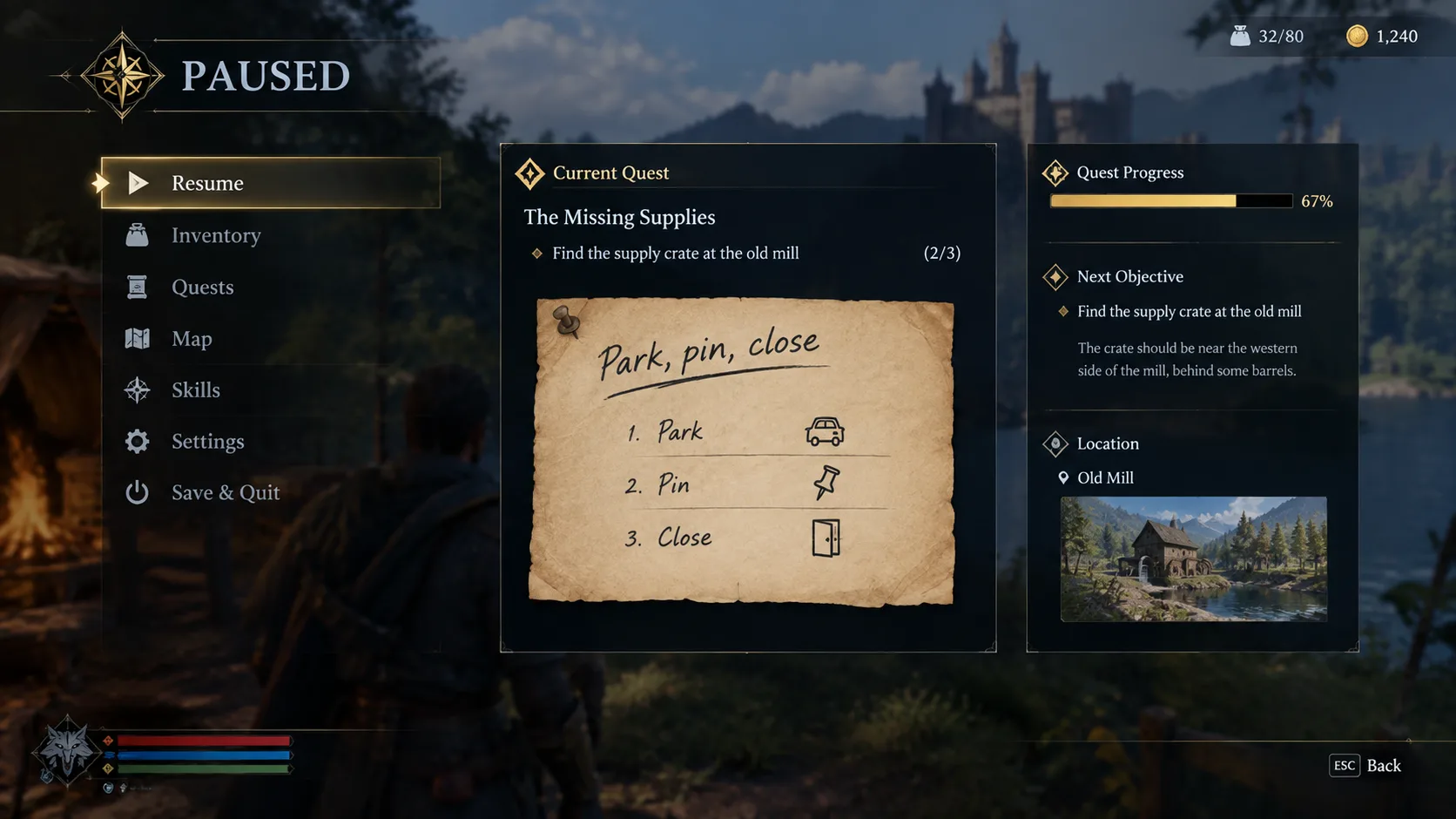
I keep a single note taped to my desk that says: "Park, pin, close." Three words. Three actions. That's the whole shutdown, and it doesn't require any planning, any reviewing, or any decision about whether the current task is finished. The note is the plan.
A Ten-Minute Shutdown That Protects Tomorrow's Save
If you take nothing else from this article, take this section. A ten-minute shutdown ritual — done before you're tired — is the difference between weeknight gaming feeling like a reward and feeling like a second job.
Step | Time | Action |
|---|---|---|
1 | 1 min | Stop the current task as it is. Don't finish it. |
2 | 3 min | Bank or sell anything that's about to overflow the inventory. |
3 | 2 min | Walk the character to the nearest save point or fast-travel marker. |
4 | 2 min | Drop a pin or write one in-game note about tomorrow's starting point. |
5 | 2 min | Close the game. Not the menu. The game. |
The whole sequence takes about ten minutes when it's smooth and fifteen when it's not. Either way, it ends with a save you can read in five seconds tomorrow. That's the whole point.
The reason I run this on a timer rather than on a feeling is that feelings lie. At 9:45pm, when the next quest step is "right there," your feelings will tell you one more minute is fine. Your feelings are wrong. The timer is right. Save your time for the fun stuff, and the fun stuff is the part where you're not exhausted and resentful.