Most RPG reviews I read answer questions I never asked. They tell me about story twists, voice acting, and how many hours of content are waiting. None of that tells me what I actually need to know: whether this game will still feel good at nine o'clock on a Tuesday, after a full workday and a kid who cannot find his backpack. So I built my own test, and I run it before I spend a single dollar.
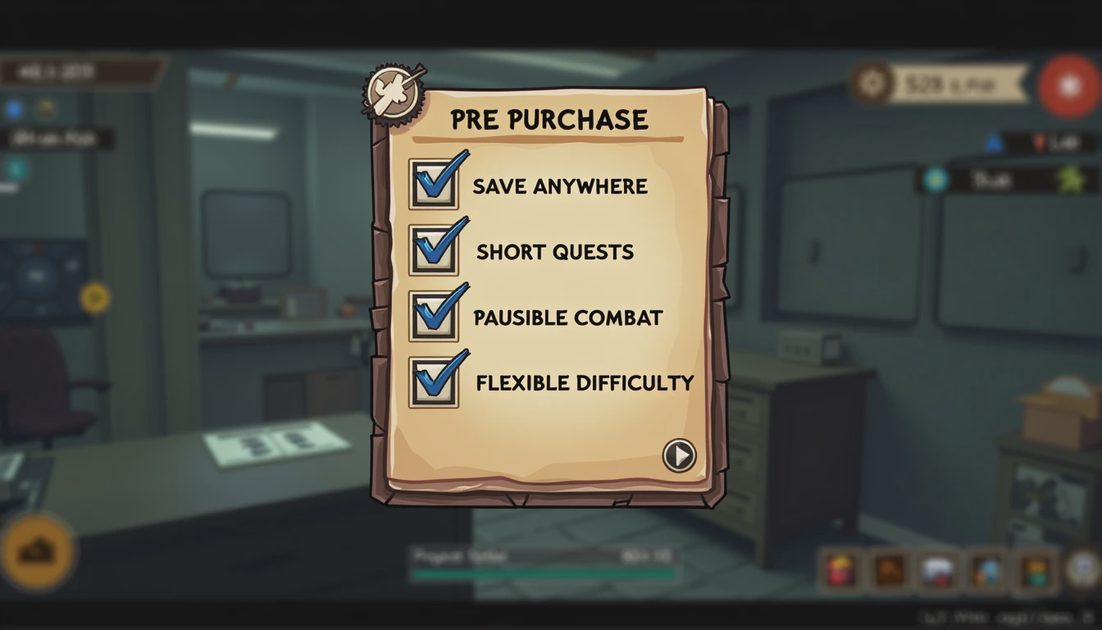
The test has four parts, and each one maps to a moment in a real adult week. Does the game save anywhere? Can I chase a quest in short pieces? Does combat end when I need it to? Will the difficulty stay fair as my attention fades at the end of a long day? Get those four right, and even the fiddlier details — including how viable RPG builds for casual players actually stay once life interrupts you for a week — tend to take care of themselves.
The Save Question Comes First
Nothing kills a new RPG faster than a save system designed for people who can block out four hours. My children are six and nine. My job occasionally pings me at odd moments. When something urgent happens mid-cutscene or mid-dungeon, the game's save rules decide whether I lose five minutes or fifty.
I used to accept save points as normal. I do not anymore. A game that only saves at story beats is assuming my evenings are predictable, and mine are not. What I look for now is either save-anywhere, or checkpoints close enough that a forced quit costs me almost nothing. If a game cannot do that, everything else it does well is fighting against my schedule.
Quests You Can Put Down and Pick Up
A quest system can be a trap even when the writing is good. A long, multi-stage objective with no natural stopping point does not care that I have to leave at nine-forty. What matters to me is whether a quest can be sliced into pieces that each feel like progress on their own.
I test this by reading how the game structures its objectives. A short chain of tasks, each finishable in one sitting, is a friendly shape. A single enormous chain that only pays off at the end will sit half-done for a week, and by the time I return I have forgotten the context. That feeling — opening a save and not remembering why I am here — is the quiet killer of adult gaming sessions.
This is also where I start paying attention to character building. If the game punishes experimentation, making skill changes expensive or permanent, then the pressure of a forgotten quest gets worse, because I start to suspect my character is wrong too. RPG builds for casual players depend on forgiveness: cheap respecs, readable skill text, and choices that do not assume I read every guide before picking.
Combat That Respects a Weeknight
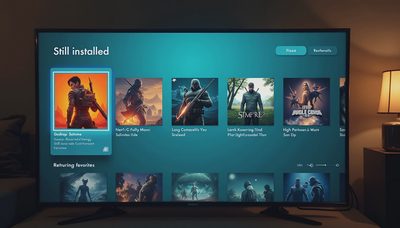
Combat is where time leaks out of an evening. A fight that runs twenty minutes and demands total attention is a weekend activity, not a weeknight one. The games I keep installed tend to share a combat rhythm: short encounters, a pause option, and deaths that send me back seconds rather than minutes.
I also watch how the game treats failure during combat. A punishing loop that forces me to redo a long approach is teaching me to respect its time, not mine. On a weeknight, my tolerance is simple: if a fight goes wrong, I want to be back in the action within a minute or two, not replaying ten minutes of walking and talking.
A Difficulty Curve That Matches Your Attention Span
Difficulty matters more to a busy adult than most reviews admit. An RPG tuned for someone who plays six hours a day assumes your brain is always warm to its systems. Mine is not. After a week away, I come back with rust, and a game that punishes rust — stat walls, sudden spikes, no way to ease down — becomes a chore list instead of a hobby.
The fix is not always an easy mode. It is flexibility: difficulty that can be adjusted mid-game, enemies that scale gently instead of spiking, and content that does not assume you cleared the optional dungeon. The same logic applies to character building. If respecs are rare and reading guides feels required, the game is quietly aimed at people with more spare time than I have. RPG builds for casual players are possible in almost any game — the difference is whether the game lets a busy adult reach them without homework.
The Pre-Purchase Test, Condensed
I turn the four questions into a small table before I buy. You can copy it into your own notes; I keep a version on scrap paper beside my monitor and run through it in about two minutes on any store page.
Check | Passes the test | Fails the test |
|---|---|---|
Saving | Save-anywhere or frequent checkpoints | Save points only, spaced far apart |
Quests | Short objectives with natural stopping points | Long chains that pay off only at the end |
Combat | Short fights, a pause option, quick recovery | Long fights, no pause, punishing resets |
Difficulty | Adjustable, gentle scaling, forgiving respecs | Spikes, stat walls, permanent skill choices |
After the table, I look for a few small signals that tend to confirm what the table already tells me:
Search for how far apart checkpoints are, not how large the world is.
Read what a respec actually costs and whether one even exists.
Find out whether combat can be paused, especially in boss fights.
Look for players describing a good stopping point in a session.
Don't overthink it. If a game fails two of the four checks, walk away and keep looking. There are plenty of RPGs that respect a busy schedule, and ignoring the ones that do not is not a loss. Keep the four questions somewhere visible, run them on every store page, and you will stop buying games you quietly abandon by the third week.